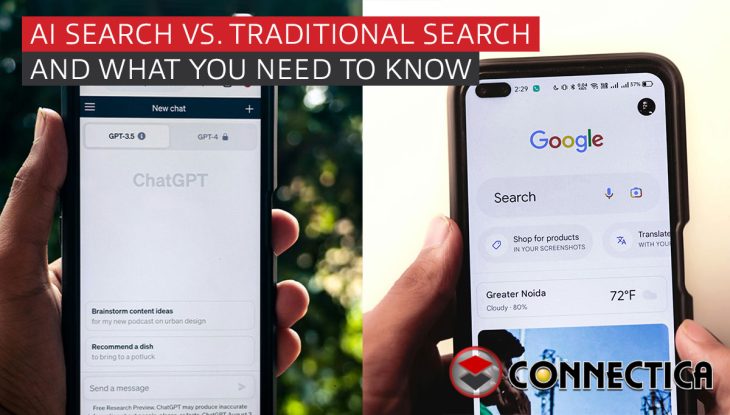
For many years, the SEO strategy that digital marketing specialists deployed was one that predominantly focused on keyword optimization. While this worked at the time, the SEO playbook is being rewritten, with zero-click answers, AI content, and solved queries all critical to whether or not you rank on search engines. Traditional search may have dominated over the past two decades, but AI search has now completely changed the game.
Today, the focus is on an approach that values intent, context, and conversation. It’s called Generative Engine Optimization (GEO) and if you want your business to soar in your industry, it’s something you’ll want to take note of.
So, how does AI search differ from traditional search?

Before we start to unpack the differences, it’s important that you understand two key elements that have changed the digital marketing field.

In late November 2022, an event happened that set in motion a fundamental shift in how online users were to use the internet. It was the launch of ChatGPT, the new online chatbot that grew to 100 million active monthly users in just two short months. To add some context as to how monumental this was, Facebook took four and half years to reach the same milestone.
In 2016, over half of all browser-based Google searches generated zero clicks. When the search giant launched AI overviews (a feature in Google Search that gives you AI-generated summaries of search results), it took zero-click functionality to an entirely new level. Similar to ChatGPT, Google began directly answering multi-step, conversational user questions — cutting out the need for users to click through to websites.
While both aim to deliver information, how they do this — and how users interact — is completely different.
Here’s a table showing the key differences:
| Feature | Traditional Search | AI Search |
| Input style | Keywords | Natural language, conversational |
| Response format | Lists of links + snippets | Synthesized answers with citations |
| Context awareness | Per-search basis | Memory across a session |
| User interaction | Scroll & click | Chat-style follow-ups |
The biggest difference between the two is undoubtedly the fact that AI search is a vastly improved user experience. It’s all about speed and convenience, key drivers of why there is a significant surge in this space. The ability to have a conversation and get specific (and relevant) answers to what you’re looking for is massively attractive to users, and all the big players understand the value of this.
It’s not without its trade-offs, though. Trust is a major factor for users, as the data or information put before them can be dated, factually incorrect, or somewhat biased. This is especially true when an AI pulls the information from unverified or low-quality sources. Without going in and fact-checking the sources for yourself, there’s a risk that what you’re being presented with is simply not correct. There are numerous AI search studies that have shone a light on this important topic.
With all of this in mind, the fact remains that if your competitor is adopting AI-best practices on their website and you aren’t, you’re unfortunately going to be left behind.
How exactly has AI changed how it views your website? There’s one keyword here — context.
In the age of generative search, Google’s algorithms are now focused heavily on contextual richness over raw keyword density. What this means is that it’s looking for content that anticipates and answers a real user question.
For example, if someone were to search “How can I prepare my home for a hurricane?”, if you were a roofing company in South Florida you’d want to make sure that you have content on your website that answers this. If you do, AI will prioritize your content over a competitor who doesn’t have this focus as it answers a fairly specific query.
Here are a few key elements that Google looks for when prioritizing AI-generated content:
That means thin, keyword-stuffed pages or AI-drafted content with no human refinement may struggle to appear in AI summaries — even if they ranked well before.

Getting noticed in AI-powered search results means adapting your SEO strategy to a more GEO-friendly one. Here’s how:
The good news is that you don’t have to do all of this yourself — a reputable SEO company will have the industry knowledge to make sure that your website follows AI-best practices.
As you can see, adapting your website to AI search is only going to become increasingly crucial as the digital space continues to evolve. While there are certain aspects you can take care of yourself, if you’re truly looking to cement your position in the AI search arena you’ll need a reputable professionals who knows the inner workings. Enter Connectica.
At Connectica, ever since AI chatbots were first whispered in digital corridors we’ve been evolving our strategies and upskilling our team to make sure that we not only know what’s happening in this space, but that we’re the experts in it.
With access to the latest AI information and trends, we’ve molded our strategies to ensure that our clients have the AI edge. Get a free AI visibility report from us to see where gaps may exist for your business, or to get in touch give our experienced team a call at 877-816-2259.
As a trusted digital marketing agency in Fort Lauderdale, we receive a wide variety of questions about SEO and what strategies make the most difference in appearing in AI search results. Here are a few of them, along with the answers.
No. Traditional SEO still drives traffic, at the moment at least. But you must also optimize for AI visibility.
If it’s thin, unverified, or copied from other sources, yes. Prioritize original, expert content — then use AI tools to assist with ideation and structure. Remember, while AI content can be created quickly, people are looking for authenticity and the human touch — and so is Google.
Review AI outputs carefully, cite authoritative sources, and clearly mark AI-generated sections with human oversight.
There are many to choose from, with new players entering the game all the time. A few we would suggest you take a look at include Google Gemini/AI Mode, Microsoft Copilot, ChatGPT, Claude AI, and Perplexity. While they mostly function the same, you’ll find that each one is tailored slightly differently.
Content that is clear, specific, current, and helpful tends to perform best. Think of well-structured blog posts, FAQ pages, how-to guides, and in-depth explainers. AI models favor content that directly answers questions, uses natural language, and demonstrates authority on the subject. Including schema markup and up-to-date information further boosts your chances of being cited.
Stay up to date on industry news and receive promotions & special offers.
Don't worry we hate spam as much as you do.
Connectica LLC
8499 West Commercial Blvd
Tamarac,
FL 33351
Toll Free: 1-877-816-2259
Local: 954-282-1698

This site is protected by reCAPTCHA · Privacy Policy · Terms of Service